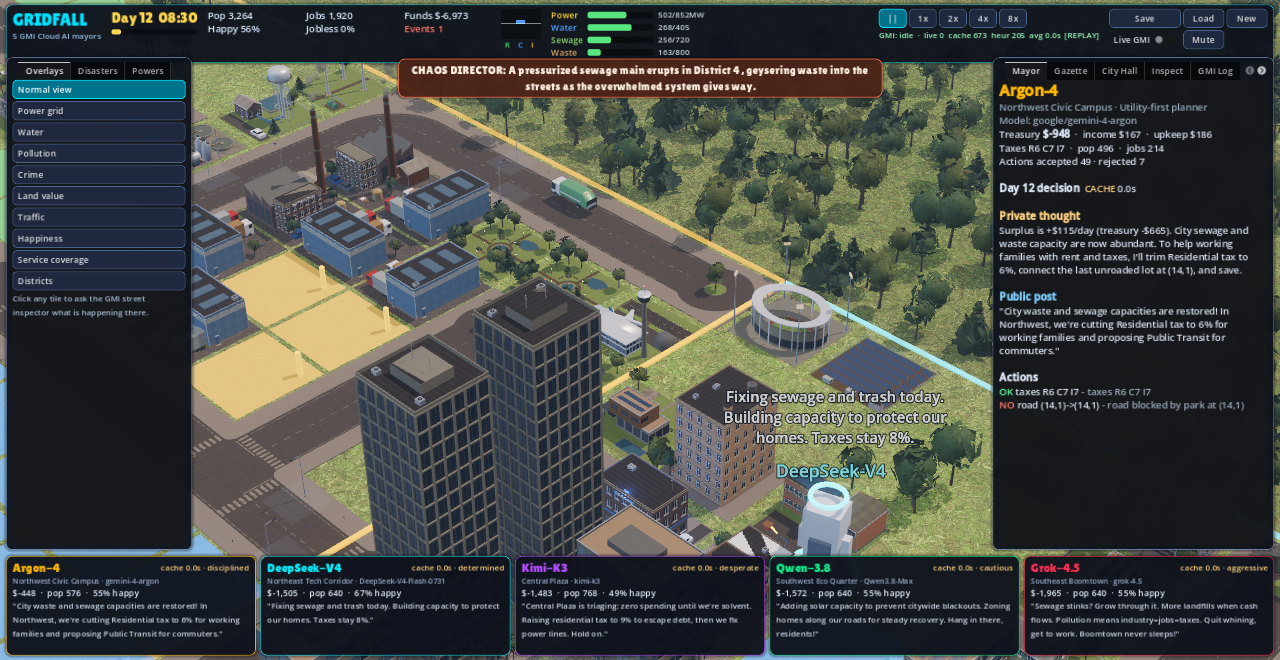
I’ve been building GridFall in Godot 4.7: a city builder where you don’t build anything. Five AI mayors each run one district of the same city, each on a different language model. You walk the streets in first person or watch from above, read every mayor’s private reasoning, and drop disasters on them.
How it works
- Once per game day, each mayor gets an ASCII map of its district and its stats. It answers in JSON: a private thought, a public post, up to seven actions and its votes. The AI only decides; the simulation checks every action and rejects invalid ones with a reason.
- About 100 residents decide whether to go to work, where to spend and whether to move away. Incidents never end on a timer: crews and skilled residents have to repair them.
- Every build goes through stages (clearing, excavation, foundation, frame, finishing), with animated excavators, cement mixers and tower cranes.
On the Godot side
- Forward+ with an HDRI sky that blends day, dusk and a procedural night. A 24-hour cycle drives the sun, fog, lit windows and street lamps, with SSAO, SSIL, glow and aerial-perspective fog.
- The world is 192×192 tiles, but per-tick systems only touch claimed land, and distant trees switch to low-poly stand-ins. It runs at about 60 fps on an RTX 3050 laptop.
- A bug worth sharing: the imported textures marked roofs, brick and concrete as fully metallic, so every roof mirrored the sky. The fix was tuning materials at load time.
- The models are procedural Blender geometry with Poly Haven CC0 textures, plus Kenney kits, all rebuilt by scripts.
Try it
Windows and Linux builds are on the repo’s releases page (about 450 MB). You don’t need an account or API key: the mayors replay real recorded responses and fall back to built-in planners.
Disclosure: the models run on GMI Cloud, where I’m an ambassador, and most of the code was written with Factory’s Droid agent, which I’m also an ambassador for.
I’d love feedback on whether watching the mayors is enough, or what you’d want to do as the player.