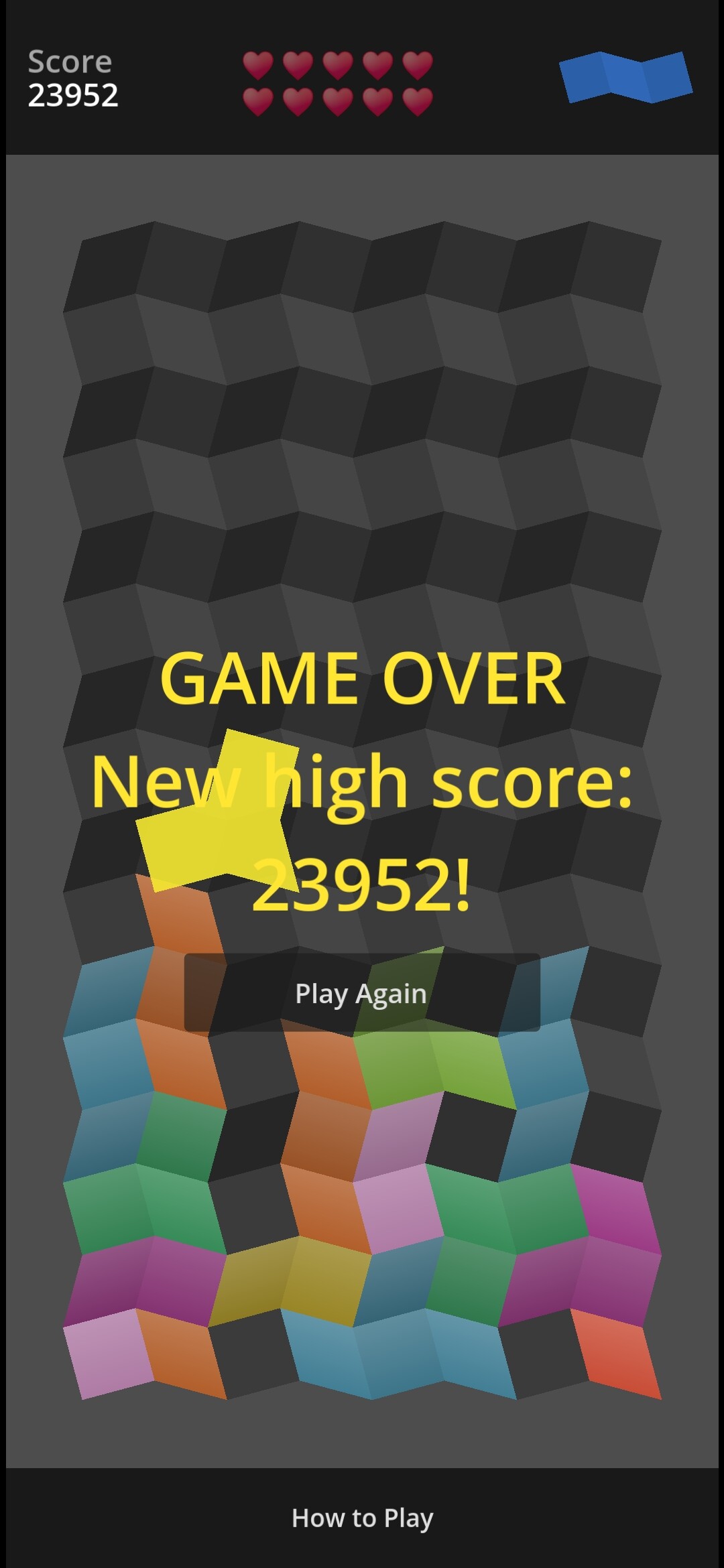
Teskyra (pronounced tes-KYE-ruh) is a falling-piece puzzle game played on an Archimedean tessellation (the “tes” in the name) where squares and diamonds alternate in a repeating pattern. The pieces are all left- or right-handed (chiral–the “kyra” in the name), and can be flipped to their opposite orientations. Pieces fall from the top (or sky) and you try to fill rows. Unlike other falling-piece puzzle games, the unusual grid means placement requires more thought: each piece must land in an empty cell that matches its shape and orientation, or it disappears (pops) and you lose a heart.
Please play it, I hope you enjoy it and I look forward to someone beating my high score!
I find the added fit-requirements unintuitive and confusing, but I suppose maybe that’s the point. A fine first effort, but I don’t think it’s for everyone.
It is definitely harder than Tetris, and I would note that describing the mechanics as “added fit-requirements” is a signal that you’re viewing it as a Tetris variant. While they are both falling-piece puzzle games, Teskyra’s geometry is entirely novel, as instead of being played on a standard grid (a square tessellation), it’s played on an Archimedean tessellation of the snub-square variety, otherwise known as 3.3.4.3.4. To map it to a grid, I doubled up the triangles in that pattern to make the diamonds.
Everything else derives from that geometry: the piece shapes, the row clearing in pairs, the chirality of the pieces (or “flipability”), and the strip mechanic to help prevent placement bottlenecks.
So yes, the difference, the originality, is the point. And yep, that makes it harder.
And you’re right, it’s not for everyone. And other feedback has been that it’s hard. So it could be that I need an easy or tutorial mode, with placement ghosts.
It takes patience to learn, and practice to master. But it rewards the focus needed, imho.
Definitely a great first project–everything works well and looks/behaves pleasantly too.
It’s definitely hard to pick up, but the more I played I felt the rules were gelling a little in mind. I’m not a huge block puzzle enthusiast, but I imagine that people who are really into such games might enjoy getting used to the challenge presented here.
Thank you kindly for this great feedback, nomad2097! I would say it’s the most comprehensive to date, and something I’ve been waiting for: someone who has actually taken the time to learn the game a bit, its subtleties, and also from someone who is clearly viewing it as its own thing, rather than some reskin of the reigning champion / grandfather of all falling-piece puzzle games.
I think it could develop a niche following, but getting over those hurdles–mainly of perception–is taking some time and effort!
I managed to get a new high score yesterday. I’ll see if I can include a speeded up video in this comment…nope…too new a user. But here’s a link to a 2x speed video.
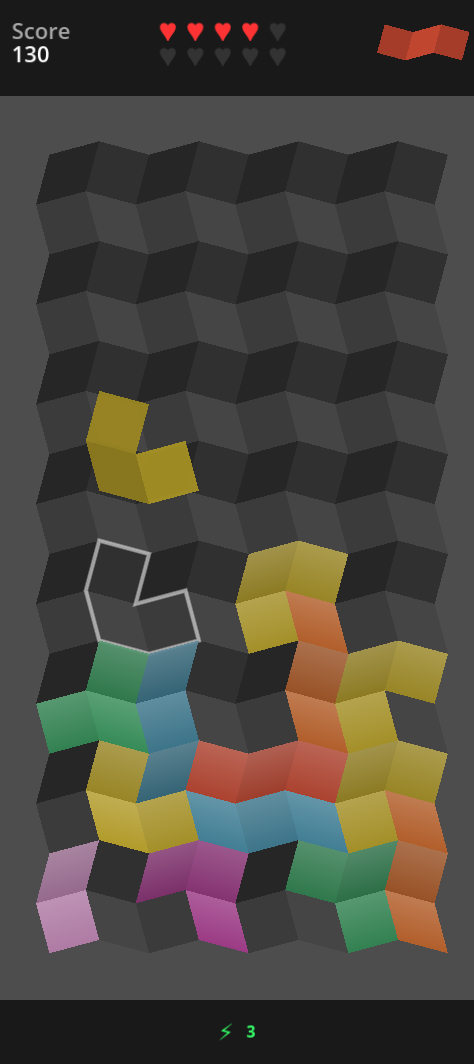
I feel it should give me the chance to fill in the lower rows too if I have a matching pattern. In the picture below the incoming yellow pattern could also fit the empty gap in the lowest row.
Certainly a very interesting way to play with geometry. It is a bit harder to pickup, harder than Tetris for sure, but maybe one could get used to it. There is a lot of visual nuances which are hard to pick up with the eye.
That’s an interesting idea that had not occurred to me! The pieces collide and stack so can’t go through each other as you’re suggesting–but it could be another added feature: like a phase shift that allows the current piece to pass through other pieces. Maybe something with charges like the Strip mechanic. Worth considering / testing out, thanks for the idea!
I’ve also considered another option which would be having the same-colour blocks clear on contact with each other. That would be a big change but would also make it easier than it is now.
I’m glad you’ve played it enough to get the hang of it–I think without the easier modes it did put off a lot of people, because it was quite a head shift to figure out the game without the help. It’s definitely hard, but rewarding too: my high score on hard core mode is 33,619!