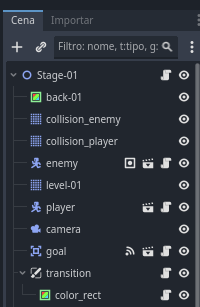
Hello bro! I made the corrections and performed the tests, but again it didn’t work, it didn’t return any errors. I added some new lines of code with “print”, but it returns “Checkpoint file does not exist”. I will provide here all the relevant files of the game.
checkpoint.gd:
extends Area2D
var is_active = false
func _on_body_entered(body):
if body.name == "player" and not is_active:
activate_checkpoint()
func activate_checkpoint():
Globals.current_checkpoint = self
Globals.current_checkpoint_scene = get_tree().current_scene.get_path()
is_active = true
Globals.save_checkpoint()
globals.gd (Global):
extends Node
var player = null
var current_checkpoint = null
var current_checkpoint_scene = ""
var checkpoint_save_path = "user://checkpoint.sav"
func _ready():
print("Globals script ready") # Adicione uma mensagem para depuração
load_checkpoint_from_file()
func _exit_tree():
print("Tree exiting, saving checkpoint") # Adicione uma mensagem para depuração
save_checkpoint()
func respawn_player():
if current_checkpoint != null:
player.position = current_checkpoint.global_position
func load_checkpoint():
if current_checkpoint != null:
return {
"position": current_checkpoint.global_position,
"scene": current_checkpoint_scene
}
return null
func save_checkpoint():
if current_checkpoint != null:
var file = FileAccess.open(checkpoint_save_path, FileAccess.WRITE)
if file:
file.store_pascal_string(current_checkpoint_scene)
file.store_var(current_checkpoint.global_position)
file.close()
print("Checkpoint saved: ", current_checkpoint_scene, current_checkpoint.global_position)
else:
print("Error opening file for writing")
func load_checkpoint_from_file():
if not FileAccess.file_exists(checkpoint_save_path):
print("Checkpoint file does not exist")
return
var file = FileAccess.open(checkpoint_save_path, FileAccess.READ)
if file:
current_checkpoint_scene = file.get_pascal_string()
var pos := file.get_var() as Vector2
file.close()
current_checkpoint = pos
print("Checkpoint loaded: ", current_checkpoint_scene, pos)
else:
print("Error opening file for reading")
goal.gd:
extends Area2D
@onready var transition = $"../transition"
@export var next_level : String = ""
func _on_body_entered(body):
if body.name == "player" and !next_level == "":
transition.change_scene(next_level)
else:
print("No Scene Loaded")
player.gd:
extends CharacterBody2D
const SPEED = 130.0
const JUMP_VELOCITY = -300.0
var direction
# Get the gravity from the project settings to be synced with RigidBody nodes.
var gravity = ProjectSettings.get_setting("physics/2d/default_gravity")
var is_jumping := false
signal player_has_died()
@onready var animation := $anim as AnimatedSprite2D
@onready var remote_transform := $remote as RemoteTransform2D
@onready var rip_effect = $rip_effect as AudioStreamPlayer
@onready var timer = $Timer
func _physics_process(delta):
# Add the gravity.
if not is_on_floor():
velocity.y += gravity * delta
# Handle jump.
if Input.is_action_just_pressed("ui_up") and is_on_floor():
velocity.y = JUMP_VELOCITY
is_jumping = true
elif is_on_floor():
is_jumping = false
# Get the input direction and handle the movement/deceleration.
# As good practice, you should replace UI actions with custom gameplay actions.
direction = Input.get_axis("ui_left", "ui_right")
if direction != 0:
velocity.x = direction * SPEED
animation.scale.x = direction
else:
velocity.x = move_toward(velocity.x, 0, SPEED)
_set_state()
move_and_slide()
func _on_hurtbox_body_entered(body):
if body.is_in_group("enemies"):
timer.wait_time = 0.5
timer.one_shot = true
rip_effect.play()
timer.start()
# Aguarda o Timer completar
await timer.timeout
emit_signal("player_has_died")
get_tree().reload_current_scene()
func follow_camera(camera):
var camera_path = camera.get_path()
remote_transform.remote_path = camera_path
func _set_state():
var state = "idle"
if !is_on_floor():
state = "jump"
elif direction != 0:
state = "run"
if animation.name != state:
animation.play(state)
func _input(event):
if event is InputEventScreenTouch:
if Input.is_action_just_pressed("ui_up") and is_on_floor():
velocity.y = JUMP_VELOCITY
is_jumping = true
elif is_on_floor():
is_jumping = false
title_screen.gd (Main Scene):
extends Control

func _ready():
    pass # Não é necessário implementar nada aqui

func _on_start_btn_pressed():
    var checkpoint_data = Globals.load_checkpoint()
    if checkpoint_data != null:
        Globals.player.position = checkpoint_data.position
        get_tree().change_scene_to_file(checkpoint_data.scene)
    else:
        get_tree().change_scene_to_file("res://levels/world_01.tscn")

func _on_new_btn_pressed():
    get_tree().change_scene_to_file("res://levels/world_01.tscn")

func _on_credits_btn_pressed():
    # Implemente conforme necessário
    pass

func _on_quit_btn_pressed():
    Globals.save_checkpoint()
    get_tree().quit()
transition.gd:
extends CanvasLayer

@onready var color_rect = $color_rect

func _ready():
	show_new_scene()

func change_scene(path: String, delay: float = 1.5):
	var scene_transition = get_tree().create_tween()
	scene_transition.tween_property(color_rect, "threshold", 1.0, 0.5).set_delay(delay)
	await scene_transition.finished
	assert(get_tree().change_scene_to_file(path) == OK)

func show_new_scene():
	var show_transition = get_tree().create_tween()
	show_transition.tween_property(color_rect, "threshold", 0.0, 0.5).from(1.0)
world.gd (Base/General):
extends Node2D

@onready var player := $player as CharacterBody2D
@onready var player_scene = preload("res://levels/player.tscn")

@onready var camera := $camera as Camera2D
# Called when the node enters the scene tree for the first time.
func _ready():
	Globals.player = player
	Globals.player.follow_camera(camera)
	Globals.player.player_has_died.connect(reload_game)


# Called every frame. 'delta' is the elapsed time since the previous frame.
func _process(delta):
	pass

func reload_game():
	await get_tree().create_timer(1.0).timeout
	var player = player_scene.instantiate()
	add_child(player)
	Globals.player = player
	Globals.player.follow_camera(camera)
	Globals.player.player_has_died.connect(reload_game)
	Globals.respawn_player()
	#get_tree().reload_current_scene()