hi i’m new to programming/coding. i’m trying to do simple things to slowly build up what kind of game i want to create, which is a small tactical rpg/deck builder
i used this tutorial (and this github with godot4 version) as a basis for my game concept. what i want to do is, when i click on a unit, i’d like for an image to appear, specifically i have a card image that i’d like to show up. eventually i want to replace it with an actual menu. i thought this might be simple for a beginner but perhaps not..
my knowledge on gdscript is still not great. i have tried using signals to have the image, or well node, appear, so for example, the card only appears when the unit is in a selected state, but i could never get it to work (i got frustrated and erased my code…), but i’m wondering if there is a simpler way that does not require me to use signals just to have a node appear when clicking on a unit, or if there something that may help me better understand signals
right now i have a card on the actual game. i can hide it from view with the hide() function
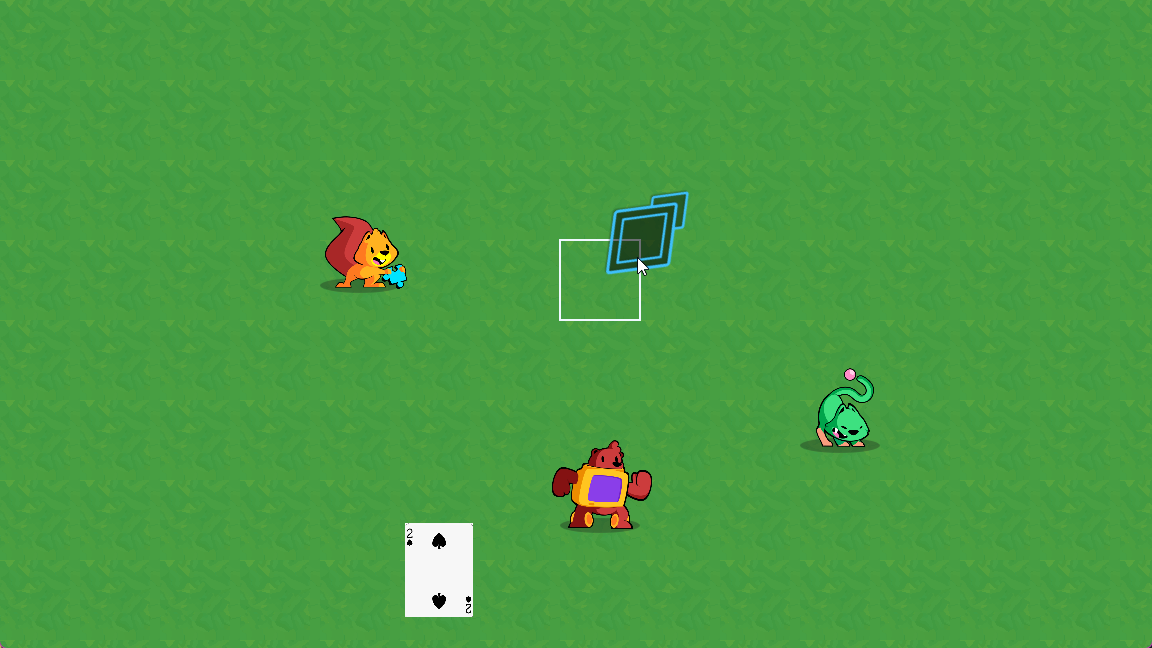
what i’d like is for it to stay hidden until a unit is selected, then it appears. and then it will hide again when the unit has made its move and is no longer selected
i dont know what code would be useful to include but i will include the script for the unit
i created a signal called active that i was going to use for the card to appear. i had code for the card but it’s been deleted
## The board manages its position inside the game grid.
## The unit itself holds stats and a visual representation that moves smoothly in the game world.
@tool
class_name Unit
extends Path2D

## Emitted when the unit reached the end of a path along which it was walking.
signal walk_finished

## Emitted when the unit is selected.
signal active

## Shared resource of type Grid, used to calculate map coordinates.
@export var grid: Resource
## Distance to which the unit can walk in cells.
@export var move_range := 6
## The unit's move speed when it's moving along a path.
@export var move_speed := 600.0
## Texture representing the unit.
@export var skin: Texture:
	set(value):
		skin = value
		if not _sprite:
			# This will resume execution after this node's _ready()
			await ready
		_sprite.texture = value
## Offset to apply to the `skin` sprite in pixels.
@export var skin_offset := Vector2.ZERO:
	set(value):
		skin_offset = value
		if not _sprite:
			await ready
		_sprite.position = value

## Coordinates of the current cell the cursor moved to.
var cell := Vector2.ZERO:
	set(value):
		# When changing the cell's value, we don't want to allow coordinates outside
		#	the grid, so we clamp them
		cell = grid.grid_clamp(value)
## Toggles the "selected" animation on the unit.
var is_selected := false:
	set(value):
		is_selected = value
		if is_selected:
			_anim_player.play("selected")
			emit_signal("active")
		else:
			_anim_player.play("idle")

var _is_walking := false:
	set(value):
		_is_walking = value
		set_process(_is_walking)

@onready var _sprite: Sprite2D = $PathFollow2D/Sprite
@onready var _anim_player: AnimationPlayer = $AnimationPlayer
@onready var _path_follow: PathFollow2D = $PathFollow2D


func _ready() -> void:
	set_process(false)
	_path_follow.rotates = false

	cell = grid.calculate_grid_coordinates(position)
	position = grid.calculate_map_position(cell)

	# We create the curve resource here because creating it in the editor prevents us from
	# moving the unit.
	if not Engine.is_editor_hint():
		curve = Curve2D.new()


func _process(delta: float) -> void:
	_path_follow.progress += move_speed * delta

	if _path_follow.progress_ratio >= 1.0:
		_is_walking = false
		# Setting this value to 0.0 causes a Zero Length Interval error
		_path_follow.progress = 0.00001
		position = grid.calculate_map_position(cell)
		curve.clear_points()
		emit_signal("walk_finished")


## Starts walking along the `path`.
## `path` is an array of grid coordinates that the function converts to map coordinates.
func walk_along(path: PackedVector2Array) -> void:
	if path.is_empty():
		return

	curve.add_point(Vector2.ZERO)
	for point in path:
		curve.add_point(grid.calculate_map_position(point) - position)
	cell = path[-1]
	_is_walking = true


func _on_button_pressed() -> void:
	pass # Replace with function body.
any information would be helpful as i am extremely new to gdscript