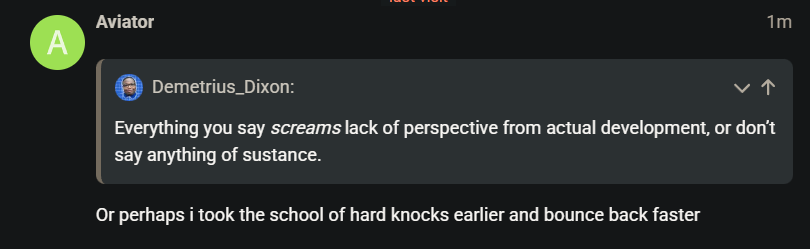
To each their own. It’s not the graphics that make that particular game fun though.
But, if you don’t like playing open world games, how come you’re trying to make one?
Which is great, if you can take a walk in the park.
I just enjoy hunting in that game. I’ve spent many hours just running around hunting rabbits and boar, and then using those skills to hunt the machines that fight back. Plus, it’s got a stellar main story. Personally, I think when the main game mechanic is just fun, regardless of whatever else happens in the game, you’ve got a winner.
Well, theyre popular, its a genre to take notice of, and although mostly AAA, the mainstream engines are powerful enough, and indy home brew devs have access to a lot of the tools.
I played open world games in the past and they were interesting although probably from a technical standpoint.
Yeah thats the point, however reviews of the Dark Souls series say its very frustrating and only addictive due to the sense of achievement after many failed attempts.
Yeah i suppose the open world adds immersion because the world seems more convincing if you can explore outside of the main story line.
Apparently Red Dead redemption 2 is organized into chapters, so likely when chapters change either the player has changed zone after completing a quest or the NPCs and world environment changes … so the world state can change but the map can be the same.
In my experience, open worlds always overpromise (massive world to explore) and then underdeliver (you realize it’s all same-y after all). It’s just the nature of the genre. The main promise of such games - to give you the whole world to “live in” - is impossible to fulfill. The reality of it is always underwhelming compared to the fantasy such promises entice. If there’s no strong classic gameplay, such games will typically disappoint their target audiences.
That is NOT the correct reason to make a game for a hellishly large amount of reasons.
Your game will most likely not be as popular as those other “popular” “open-world” games. Not because you’re better or worse, but because you’re going to be starting from scratch, while they aren’t.
Do you like open-world games? If you don’t, you won’t make it to a finished game. Game development is one of THE most demanding and headache-filled arts in existence. I know from experience.
By the time it takes to finish your game (YEARS), the gaming landscape will’ve changed, for better or worse. You can’t rely on a future that doesn’t exist.
What do you actually want to achieve out of game development? Because your mindset, from what I’ve seen, isn’t sustainable.
I haven’t said this in a while, but it still holds true:
Game development is a lifestyle. You can’t just work “here-and-there” and expect to make any meaningful progress or learn anything of value. You gotta commit a lot of time and forge a lot of social connections to make it work.
Just a tiny factoid to keep in mind when talking about making open world games. Red Dead Redemption 2 team consisted of 1500 - 3000 people, depending on how you count.
Well i wasnt making an Assassins creed look-alike because my animation and animation code isnt that advanced …
Theres a lot of polish that an indy homebrew dev should avoid, because its just pointless for certain projects, especially if the game is scaled back to a realistic achievable standard. For example fluffy moustache hair shaders arent worth my time, if theres a free MIT licenced hair shader I might use it.
I really think they didnt have that many people in the office.
I used to work on games a long time ago, and getting back into it was fun because of how the tech has actually advanced. I want to tell my story whatever that may be (cryptic).
Yeah, thats a point, thats why accelerating development time is a key topic.
Some of my motive is maybe proving my ability as a writer, an artist, and a developer. I can give you a game with one polished map today … i am not going to do that … you would see how the game has potential but basically sucked in scope, story, and playable content.
The concept of “office” loses meaning in projects of such scope and magnitude. That’s the ballpark of the number of people who were working on it, in or out of the office.
Hmm yeah its obvious they all did extra work, compared to previous generations, on the quality in every aspect, a truly perfectionist effort … if they need an advanced tool, theyve probably got it, and its probably all closed source, in-house, bespoke -very high quality-code.
So theres obviously millions of ways home brew development can go, im looking at two extrenes, either sketchy and massive, or polished and small, both are achievable, but i might tend to avoid ‘super massive’ or ‘super polished’ because they’re took much work.
Hmm i am learning the art of writing, a lot of its all about description, and so useless because we do that using graphics, but character development, conversation, plot, and adding depth and context is appropriate to games.
Gameplay/mechanics is what imo makes or breaks the game. A good mechanics may work well in both - tiny or massive world. Ditto for the narrative. A drama of the same intensity can play out in a couple of rooms or across the continents. So I’d start with the core mechanics as the main priority, not with the size of the world.
It may sound counter-intuitive but solving technicalities of massive world management or procedural generation is like a vacation compared to inventing and implementing solid gameplay. The former is mostly tinkering with known methods while the latter requires creativity and a lot of focused thinking, unless you’re making a clone. That’s why we see so many people start with terrain generators and then the project just dwindles when the time comes to build actual gameplay on top of them.
This maybe relevant as I’ve looking at NPC AI using behavior trees to make a game more efficient.
Behavior trees (BTs) make distant objects more efficient by allowing developers to easily switch to lower-fidelity, less frequent, or event-driven updates. BTs facilitate modularity, enabling the use of simpler, “cheaper” logic trees for distant NPCs. When combined with techniques like variable tick rates, BTs minimize unnecessary calculations, optimizing performance.
You can google around for BTs and how they work. There are a couple of Godot addons that allow you to use BTs.
The forum didnt want to take my screen ahots. The game was called Crimson Souls Deliverance (just kidding).
Tried some sweeping vistas with various settings (my copy of sky3d is broken), including depth of field and shorter far clip.
And the snag case viewing the woods from a distance …
Yeah i have already tried LimboAi but my test is still in very sketchy state for 3d because they didnt make a 3d demo. I tried converting the demo npcs to 3d and i just need an exanple with the HSM.
Yeah its walkable at 8km × 8km only using a 2k × 2k heightmap however i was planning on upscaling. The shader is a Multisplat 16. The ground textures are all extra large at the moment, so it looks very retro, but that isnt the eventual plan.
I used to run the player at 70 kmph lol.
Now i just drag the player in the editor for localized testing.
Its usually about 30- 40 fps when i run the computer in 25 watt mode, however its usually in 10 watt mode to save power, and fps drops to 20 fps. The snag case slows everything to a crawl.
Only solutions i have for the snag cases is to put rocks in the way or add some hills with occlusion planes, or maybe the game goes into a canyon then on the other side the trees are all simple billboards ….
Those framerates sound a bit low. I’ll repeat - you need to partition.
Ultimately you could ditch Godot’s scene tree completely and instead manage your own streaming scene graph that issues calls to Godot’s servers. It’d be preferable to do this in native code but a quick proof-of-concept prototype could be made in GDScript first.