Godot Version
4.6
Question
Abstract: I’m trying to program a buoyancy system for RigidBody objects that uses the actual vertex height of the water as set by a shader instead of just the objects world postion. Programming wizzards please save me.
Details: I’ve watched a few tutorials but fundamentally don’t understand shaders lol. From what I’ve found, I need to make a GDscript version of the shader’s height code, any help doing so would be greatly appreciated.
Resources:
One buoyancy solution I found (I’d have used this project directly but I did’t like the water style) -
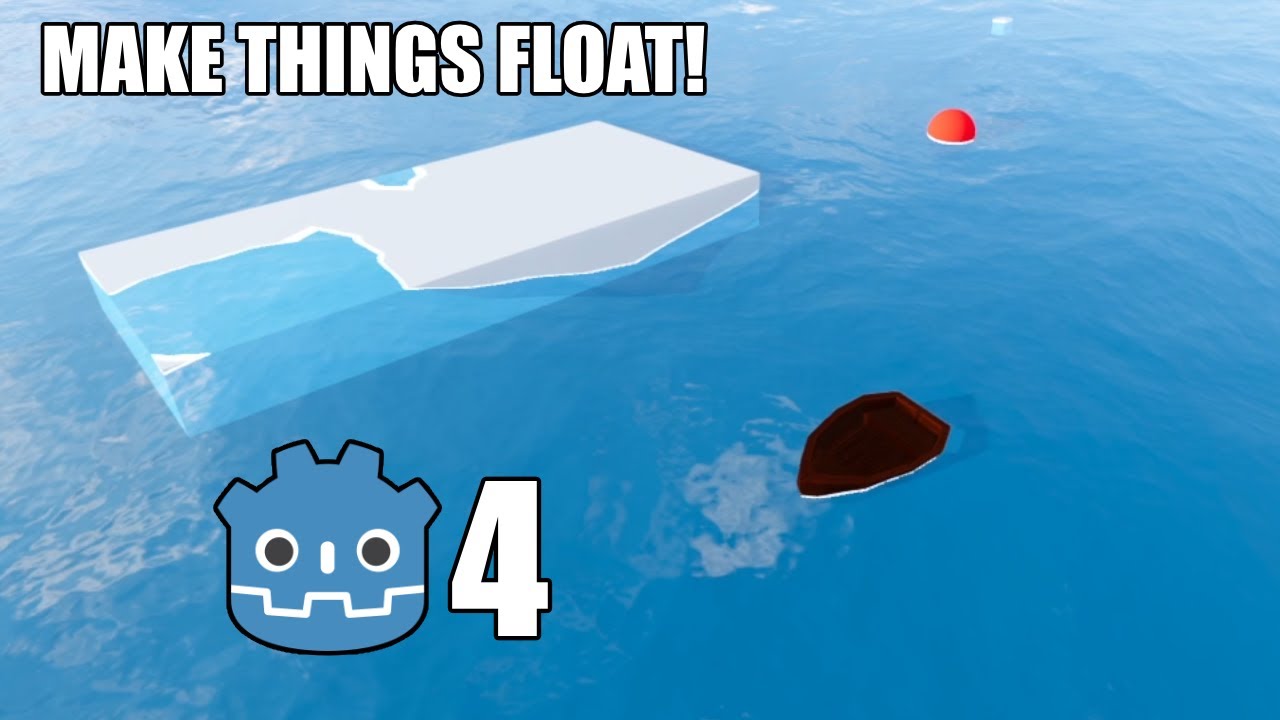
Current water shader –
shader_type spatial;

render_mode depth_draw_always;

const float EPSILON = 1e-5;

uniform sampler2D SCREEN_TEXTURE : hint_screen_texture, filter_nearest;
uniform sampler2D DEPTH_TEXTURE : hint_depth_texture, filter_nearest;

uniform vec3 color_shallow : source_color = vec3(0.01, 0.2, 0.3);
uniform vec3 color_deep : source_color = vec3(0.3, 0.5, 0.6);

uniform float transparency : hint_range(0.0, 1.0, 0.01) = 0.6;
uniform float metallic : hint_range(0.0, 1.0, 0.01) = 0.0;
uniform float roughness : hint_range(0.0, 1.0, 0.01) = 0.25;

uniform float max_visible_depth : hint_range(0.1, 100.0, 0.1) = 20.0;

uniform sampler2D wave_a;
uniform sampler2D wave_b;
uniform vec2 wave_move_direction_a = vec2(-1.0, 0.0);
uniform vec2 wave_move_direction_b = vec2(0.0, 1.0);
uniform float wave_noise_scale_a = 15.0;
uniform float wave_noise_scale_b = 15.0;
uniform float wave_time_scale_a = 0.15;
uniform float wave_time_scale_b = 0.15;
uniform float wave_height_scale = 1.0;
uniform float wave_normal_flatness : hint_range(0.1, 100.0, 0.1) = 50.0;

uniform sampler2D surface_normals_a;
uniform sampler2D surface_normals_b;
uniform vec2 surface_normals_move_direction_a = vec2(-1.0, 0.2);
uniform vec2 surface_normals_move_direction_b = vec2(0.2, 1.0);
uniform float surface_texture_roughness : hint_range(0.0, 1.0, 0.01) = 0.15;
uniform float surface_texture_scale : hint_range(0.001, 2.0, 0.001) = 0.1;
uniform float surface_texture_time_scale : hint_range(0.001, 2.0, 0.001) = 0.06;

uniform float ssr_resolution   : hint_range(0.01, 10.0, 0.1)	= 1.0;
uniform float ssr_max_travel   : hint_range(0.0, 200.0, 0.1) 	= 30.0;
uniform float ssr_max_diff     : hint_range(0.1, 10.0, 0.1) 	= 4.0;
uniform float ssr_mix_strength : hint_range(0.0, 1.0, 0.01) 	= 0.7;
uniform float ssr_screen_border_fadeout: hint_range(0.0, 1.0, 0.1)	= 0.3;

uniform float refraction_intensity : hint_range(0.0, 1.0, 0.01) = 0.4;

uniform vec3  border_color : source_color = vec3(1.0);
uniform float border_scale : hint_range(0.0, 5.0, 0.01) = 2.0;
uniform float border_near = 0.5;
uniform float border_far = 300.0;

uniform float cut_out_x = 0.0;
uniform float cut_out_z = 0.0;

varying vec2 vertex_uv;
varying vec3 local_position;

float get_wave_height(vec2 uv_a, vec2 uv_b)
{
float height1 = texture(wave_a, uv_a).y;
float height2 = texture(wave_b, uv_b).y;
return (height1 + height2) / 2.0;
}

vec3 get_mixed_normals(vec3 color1, vec3 color2)
{
vec3 normal1 = normalize(color1 * 2.0 - 1.0);
vec3 normal2 = normalize(color2 * 2.0 - 1.0);
vec3 up = vec3(0.0, 0.0, 1.0);
vec3 tangent = normalize(normal1 + normal2);
vec3 binormal = normalize(cross(up, tangent));
vec3 mixedNormal = normalize(cross(tangent, binormal));
return mixedNormal * 0.5;
}

void vertex()
{
local_position = VERTEX;

vertex_uv = (MODEL_MATRIX * vec4(local_position, 1.0)).xz;
vec2 uv_a = vertex_uv / wave_noise_scale_a + (wave_move_direction_a * TIME * wave_time_scale_a);
vec2 uv_b = vertex_uv / wave_noise_scale_b + (wave_move_direction_b * TIME * wave_time_scale_b);
VERTEX.y += get_wave_height(uv_a, uv_b) * wave_height_scale;

float normal_height_scale = wave_height_scale / wave_normal_flatness;
vec2 e = vec2(0.01, 0.0);
vec3 normal = normalize(vec3(
	get_wave_height(uv_a - e, uv_b - e) * normal_height_scale - get_wave_height(uv_a + e, uv_a + e) * normal_height_scale,
	2.0 * e.x,
	get_wave_height(uv_a - e.yx, uv_b - e.yx) * normal_height_scale - get_wave_height(uv_a + e.yx, uv_b + e.yx) * normal_height_scale
	));
NORMAL = normal;

}

bool is_within_screen_boundaries(vec2 position)
{
return position.x > 0.0 && position.x < 1.0 && position.y > 0.0 && position.y < 1.0;
}

vec2 get_uv_from_view_position(vec3 position_view_space, mat4 proj_m)
{
vec4 position_clip_space = proj_m * vec4(position_view_space.xyz, 1.0);
vec2 position_ndc = position_clip_space.xy / position_clip_space.w;
return position_ndc.xy * 0.5 + 0.5;
}

vec3 get_view_position_from_uv(vec2 uv, float depth, mat4 inv_proj_m)
{
vec4 position_ndc = vec4((uv * 2.0) - 1.0, depth, 1.0);
vec4 view_position = inv_proj_m * position_ndc;
return view_position.xyz /= view_position.w;
}

bool is_zero(float value)
{
return abs(value) < EPSILON;
}

float get_screen_border_alpha(vec2 screen_position)
{
vec2 shifted_screen_position = 4.0 * screen_position * (1.0 - screen_position);
float mask = shifted_screen_position.x * shifted_screen_position.y; // ranging from 0.0 at the edges to 1.0 in the center

// An offset in the [0.0, 0.5] range for ssr_screen_border_fadeout values > 0.75
// which is subtracted from the result of smoothstep.
// This ensure alpha smoothly transitions to zero when ssr_screen_border_fadeout is approaching 1.0.
float offset = mix(0.0, 0.5, (clamp(ssr_screen_border_fadeout, 0.75, 1.0)-0.75) / 0.25);
float alpha = clamp(smoothstep(0.0, 2.0 * ssr_screen_border_fadeout, mask) - offset, 0.0, 1.0);

return is_zero(ssr_screen_border_fadeout) ? 1.0 : alpha;

}

vec4 get_ssr_color(vec3 surface_view_position, vec3 normal_view_space, vec3 view_view_space, mat4 proj_m, mat4 inv_proj_m)
{
if (ssr_max_travel < EPSILON)
{
return vec4(0);
}

vec3 current_position_view_space = surface_view_position;
vec3 view_direction_view_space = view_view_space * -1.0;
vec3 reflect_vector_view_space = normalize(reflect(view_direction_view_space.xyz, normal_view_space.xyz));

vec2 current_screen_position = vec2(0.0);

vec3 resulting_color = vec3(-1.0);
for(float travel=0.0; resulting_color.x < 0.0 && travel < ssr_max_travel; travel = travel + ssr_resolution)
{
	current_position_view_space += reflect_vector_view_space * ssr_resolution;
	current_screen_position = get_uv_from_view_position(current_position_view_space, proj_m);

	float depth_texture_probe_raw = texture(DEPTH_TEXTURE, current_screen_position).x;
	vec3 depth_texture_probe_view_position = get_view_position_from_uv(current_screen_position, depth_texture_probe_raw, inv_proj_m);

	float depth_diff = depth_texture_probe_view_position.z - current_position_view_space.z;

	vec3 ssr_screen_color = texture(SCREEN_TEXTURE, current_screen_position.xy).rgb;
	resulting_color = (is_within_screen_boundaries(current_screen_position) && depth_diff >= 0.0 && depth_diff < ssr_max_diff) ? ssr_screen_color : vec3(-1.0);
}

float alpha = get_screen_border_alpha(current_screen_position);
return vec4(resulting_color,alpha);

}

float linear_depth(float cur_depth)
{
return border_far * border_near / (border_near + cur_depth * (border_far - border_near));
}

float normalize_float(float min_v, float max_v, float value)
{
float clamped_value = clamp(value, min_v, max_v);
return  (clamped_value - min_v) / (max_v - min_v);
}

vec2 get_refracted_uv(vec2 raw_screen_uv, float screen_depth_raw, vec3 view, vec3 normal, mat4 proj_m, mat4 inv_proj_m)
{
vec3 screen_view_position_original = get_view_position_from_uv(raw_screen_uv, screen_depth_raw, inv_proj_m);
float screen_center_distance = clamp(abs(length(raw_screen_uv - vec2(0.5, 0.5))) * 2.0, 0.0, 1.0);
float refraction_intensity_deglitched = mix(1.0 - refraction_intensity, 1.0, screen_center_distance);
vec3 refraction_position_view_space = screen_view_position_original + normalize(refract(view, -normal, refraction_intensity_deglitched));
vec2 refraction_uv = get_uv_from_view_position(refraction_position_view_space, proj_m);
return refraction_uv;
}

void fragment()
{
vec3 normal = NORMAL;

float screen_depth_raw = texture(DEPTH_TEXTURE, SCREEN_UV).x;

vec2 refraction_uv = refraction_intensity > 0.0 ? get_refracted_uv(SCREEN_UV, screen_depth_raw, VIEW, normal, PROJECTION_MATRIX, INV_PROJECTION_MATRIX) : SCREEN_UV;

float screen_depth = texture(DEPTH_TEXTURE, refraction_uv).x;
float surface_depth = FRAGCOORD.z;

float border_diff = linear_depth(screen_depth_raw) - linear_depth(surface_depth);

vec2 time_vector = (TIME * surface_normals_move_direction_a) * surface_texture_time_scale;
vec2 time_vector2 = (TIME * surface_normals_move_direction_b) * surface_texture_time_scale;

vec3 normal_texture_blend 	= get_mixed_normals(texture(surface_normals_a, vertex_uv * surface_texture_scale + time_vector).xyz, texture(surface_normals_b, vertex_uv * surface_texture_scale + time_vector2).xyz);
vec3 normal_blend 			= mix(normal, normal_texture_blend, surface_texture_roughness);

vec3 screen_view_position 	= get_view_position_from_uv(refraction_uv, screen_depth, INV_PROJECTION_MATRIX);
vec3 surface_view_position 	= get_view_position_from_uv(SCREEN_UV, surface_depth, INV_PROJECTION_MATRIX);
float depth_visibility 		= 1.0 - normalize_float(0.0, max_visible_depth, length(surface_view_position - screen_view_position));

vec3 screen_color 				= texture(SCREEN_TEXTURE, refraction_uv).rgb;
vec4 ssr_color 					= get_ssr_color(surface_view_position, normal, VIEW, PROJECTION_MATRIX, INV_PROJECTION_MATRIX);
vec3 surface_color_transparency	= mix(color_shallow, screen_color, transparency);
vec3 surface_depth_color_mix 	= mix(color_deep, surface_color_transparency, depth_visibility);
vec3 surface_color_ssr_mix		= (ssr_max_travel > EPSILON) ? mix(surface_depth_color_mix, ssr_color.rgb, ssr_mix_strength * ssr_color.a) : vec3(0);
vec3 water_color 				= (ssr_color.x >= 0.0) ? surface_color_ssr_mix : surface_depth_color_mix;
vec3 final_color				= mix(border_color, water_color, step(border_scale, border_diff));

float cut_out_x_half = cut_out_x / 2.0;
float cut_out_z_half = cut_out_z / 2.0;

if((local_position.x < cut_out_x_half && local_position.x > -cut_out_x_half) &&
(local_position.z < cut_out_z_half && local_position.z > -cut_out_z_half))
{
	discard;
}

ALBEDO.rgb = final_color;
METALLIC = metallic;
ROUGHNESS = roughness;
NORMAL = normal_blend;

}
Current Water code (What I wrote this with NO idea what’s going on) -
extends MeshInstance3D
class_name Water


var material: ShaderMaterial;

var noise_a: Image;
var noise_scale_a: float;
var wave_speed_a: float;

var noise_b: Image;
var noise_scale_b: float;
var wave_speed_b: float;

var height_scale: float;

var time: float;

# Called when the node enters the scene tree for the first time.
func _ready():
	material = mesh.surface_get_material(0);


	noise_a = material.get_shader_parameter("wave_a").noise.get_seamless_image(512, 512);
	noise_scale_a = material.get_shader_parameter("wave_noise_scale_a");
	wave_speed_a = material.get_shader_parameter("wave_time_scale_a");

	noise_b = material.get_shader_parameter("wave_b").noise.get_seamless_image(512, 512);
	noise_scale_b = material.get_shader_parameter("wave_noise_scale_b");
	wave_speed_b = material.get_shader_parameter("wave_time_scale_b");

	height_scale = material.get_shader_parameter("wave_height_scale");
	return;


# Called every frame. 'delta' is the elapsed time since the previous frame.
func _process(delta):
	time += delta;
	material.set_shader_parameter("wave_time", time);
	return;

func getHeightAt(world_position: Vector3) -> float:


	## A
	var uv_xA = wrapf(world_position.x / noise_scale_a + time * wave_speed_a, 0, 1);
	var uv_yA = wrapf(world_position.z / noise_scale_a + time * wave_speed_a, 0, 1);

	var pixel_posA = Vector2(uv_xA * noise_a.get_width(), uv_yA * noise_a.get_height());
	var heightA: float =  + noise_a.get_pixelv(pixel_posA).r * height_scale;


	## B
	var uv_xB = wrapf(world_position.x / noise_scale_b+ time * wave_speed_a, 0, 1);
	var uv_yB = wrapf(world_position.z / noise_scale_b+ time * wave_speed_a, 0, 1);

	var pixel_posB = Vector2(uv_xB * noise_a.get_width(), uv_yB * noise_a.get_height());
	var heightB: float = noise_a.get_pixelv(pixel_posB).r * height_scale;


	print("A: " + str(heightA) + " B: " + str(heightB));

	# Together

	return global_position.y + (heightA + heightB)/2;